Test #1 · Video comes out Sunday, Oct 18 · 12:00 PM ET
Dave Ramsey's 8% withdrawal rule: we tested it on 21 retirees
The video
The video comes out Sunday, Oct 18 · 12:00 PM ET.
Subscribe on YouTube to see it the minute it's up, or get the free weekly email for the full numbers.
BUSTEDfor anyone who can't choose their retirement year
The short answer
Not for most retirees. Taking 8% a year, raised with inflation, ran out of money for 12 of the 13 people who retired from 1996 through 2008, using real S&P 500 returns with dividends. The 4% rule ran out for none of them. 8% only worked for people who retired right after a crash, and nobody gets to pick that.
The key numbers
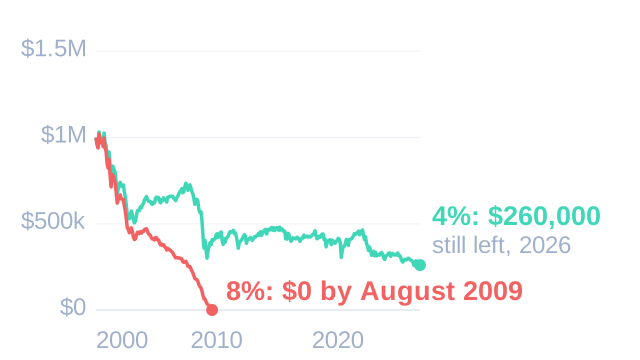
- Retire in January 2000 with $1,000,000 and take 8% raised with inflation: the money is gone by August 2009, after 9.6 years.
- 8% ran out of money for 12 of 13 people who retired from 1996 through 2008. The one survivor (2003) has $106,432 left, less than one year's withdrawal.
- The 4% rule ran out for none of them. The 2000 retiree still has $260,335 (October 2026).
- Ramsey's "conservative" 7% also ran out for 6 of 13.
The claim
Dave Ramsey told a caller on The Ramsey Show in November 2023 that retirees can take 8% a year out of stock mutual funds: if the funds make about 12% and inflation takes about 4%, that leaves 8%. He called 7% the conservative choice, and called people who push the 4% rule "goobers".
Source: InvestmentNews, Emile Hallez, November 30, 2023
How we tested it
- $1,000,000 retired on the first trading day of January, for every start year from 1996 to 2016: 21 retirees.
- All of it in the S&P 500 with dividends reinvested (the SPY fund), as Ramsey suggests for stock mutual funds. Real daily prices from 1996 to October 2026.
- 8% taken out monthly: $80,000 in year one, raised every year with inflation (the government's consumer price index).
- Compared with 8% that is never raised, and with the 4% rule ($40,000 in year one, raised with inflation). We also ran 5%, 6% and 7%.
- No fees and no taxes. Both would make every result worse.
What happened to someone who retired in January 2000?
They retired with $1,000,000 and took $80,000 the first year, raised with inflation after that. The market fell hard from 2000 to 2002 and again in 2008, and the withdrawals kept coming out while prices were down. The money was gone in August 2009, after 9.6 years and $861,210 paid out.
Same person, same years, taking 4% instead: $260,335 is still there in October 2026, and they're now taking $77,259 a year. Not comfortable, but still paying.
Did taking 8% work for anyone?
Yes: everyone who retired from 2009 to 2016. They started right after the 2008 crash, into the longest bull market on record. Retire in January 2009, take 8%, and $4,492,132 is left today. But those retirees have only 11 to 18 years of data so far, not 30.
That's the problem with the 8% rule. The same stocks with the same average return gave one retiree $4.5 million and wiped out another. The difference was the year they retired.
Why doesn't the math work if the market averages 11.8%?
Ramsey's average is right for this period: the simple average of the S&P 500's yearly returns from 1996 to 2025 was 11.76%. But money actually grew 10.21% a year, because losses hurt more than gains help. Lose 36.8% in 2008, gain 26.4% in 2009, and you're 20% poorer, even though the two years "average" a loss of only 5.2%.
The bigger problem is order. Money taken out while the market is down is gone for good, so it never gets the recovery. Advisers call this sequence risk. And inflation averaged 2.53% a year, lower than Ramsey's 4%, and 8% still failed.
| Retired | 8% raised with inflation | 4% rule |
|---|---|---|
| 1996 | ran out Aug 2020 | $9,814,199 |
| 1997 | ran out Nov 2016 | $7,193,242 |
| 1998 | ran out Feb 2012 | $3,542,850 |
| 1999 | ran out Mar 2010 | $1,324,176 |
| 2000 | ran out Aug 2009 | $260,335 |
| 2001 | ran out Oct 2011 | $1,872,443 |
| 2002 | ran out Sep 2014 | $3,358,607 |
| 2003 | $106,432 | $6,619,792 |
| 2004 | ran out Jan 2021 | $4,687,087 |
| 2005 | ran out Sep 2021 | $4,294,300 |
| 2006 | ran out Jul 2023 | $4,190,859 |
| 2007 | ran out Oct 2022 | $3,568,729 |
| 2008 | ran out Sep 2025 | $3,695,898 |
| 2009 | $4,492,132 | $7,992,185 |
| 2010 | $3,299,801 | $6,256,468 |
| 2011 | $2,954,823 | $5,507,382 |
| 2012 | $3,533,908 | $5,700,254 |
| 2013 | $3,029,355 | $4,873,450 |
| 2014 | $2,098,522 | $3,678,024 |
| 2015 | $1,849,442 | $3,220,521 |
| 2016 | $2,235,009 | $3,416,292 |
Money left is in October 2026 dollars. Only the 1996 retiree has a full 30 years of data; the 2009 to 2016 retirees have 11 to 18 years so far.
The verdict
BUSTED for anyone who can't choose their retirement year. 8% worked if you retired right after a crash and failed for almost everyone who retired before one. Ramsey's own "conservative" 7% also ran out for 6 of 13.
What this test leaves out
- Only the 1996 retiree has a full 30 years of data. Later start years are still running.
- No fees or taxes. Both would make every result worse, and IRA withdrawals are usually taxed.
- 100% stocks, as Ramsey suggests. The classic 4% rule assumed a mix of stocks and bonds; this test had no bonds.
- One country and one 30-year stretch of history. Start years overlap, so they aren't independent tests.
Data: S&P 500 total return (SPY) 1996 to Oct 2026; inflation: BLS CPI; monthly withdrawals; no fees, no taxes. Every number on this page comes from the test results.
Get the full numbers, free
One email a week: the tables, the charts, and what we're testing next.
Box not loading? Sign up on Substack. Free. Unsubscribe anytime.
Questions people ask
- Is it safe to withdraw 8% a year in retirement?
- In this test, no. Taking 8% a year, raised with inflation, ran out of money for 12 of 13 people who retired from 1996 through 2008, all in the S&P 500 with dividends. It only lasted for people who retired right after a crash.
- What is Dave Ramsey's 8% rule?
- Dave Ramsey has said retirees can take 8% a year from stock mutual funds, because the funds earn about 12% and inflation takes about 4%. He said it on The Ramsey Show in November 2023.
- How long did $1 million last at 8% for someone who retired in 2000?
- 9.6 years. Taking $80,000 the first year, raised with inflation, the money was gone in August 2009.
- Did the 4% rule work?
- It never ran out for any of the 13 retirees who started from 1996 to 2008. The worst start, January 2000, is down to $260,335 from $1,000,000, so it is hanging on, not comfortable.
- What withdrawal rate survived every start year?
- Raised with inflation, 4% survived every start from 1996 to 2008. 5% ran out for 3 of 13, 6% for 5 of 13 and 7% for 6 of 13. The highest rate that survived a January 2000 retirement was 4.1%.
- What about taking 8% of whatever you have each year?
- It never runs out, but the paycheck moves with the market. Retire in 2000: $80,000 the first year, $27,547 in 2009 (a two-thirds pay cut), back to $71,406 in 2026.
More tests
Education and entertainment only. Not personal financial advice. Your situation is different; talk to a professional before changing how you withdraw your retirement money. Disclosure: I don't own an S&P 500 index fund. I do own some individual stocks, including Apple, which is part of the S&P 500. Nobody paid for this video.